Pathfinder Strategies partners with industry leaders, public agencies, philanthropy, and sector intermediaries to design talent systems aligned with real labor market demand — and to build the connective tissue that makes them durable.
The goal of workforce development is straightforward: learners reach good jobs, and employers find the talent they need to grow. Those two outcomes rise and fall together — and Pathfinder Strategies' work is grounded in a clear thesis about what it takes to deliver both at scale.
Workforce efforts can't scale — or deliver for learners — unless employers are genuinely at the table. Employers hold knowledge no other actor can supply about where work is headed and what it takes to prepare people for it. When that signal shapes what gets built, learners land in jobs that actually exist.
The dominant model of employer engagement — gathering input on plans already made, and participation in programs already developed — asks much of employers while giving their voice little weight. Employers stay when solutions are designed with them and employer voice visibly shapes decisions and results.
No single employer, program, or agency can transform a talent system alone. Lasting results come from the connective tissue that links employers with education and training partners — sector intermediaries, regional partnerships, or structures inside public systems. Treated as core infrastructure, it turns employer partnership into results at scale.
Engagements range from focused advisory projects to multi-year system-building partnerships.
Set direction for workforce investments, policy, and system architecture.
Move employers from advisory input to genuine leadership within talent systems.
Turn strategy into working operations — and step in when initiatives need experienced hands.
Equip the field with the evidence, tools, and skills to sustain the work.
A sample of recent work across states, funders, and national organizations.
Helped CareerWise evolve from a state-based model into a national apprenticeship organization, shaping the strategy and operational plans behind its expansion.
Provided two years of technical assistance to Career Connect Washington's ten sector leaders, strengthening employer engagement statewide.
Co-led a cross-state collaborative of fourteen workforce leaders advancing the case for employer leadership in public talent systems.
Chaired the Workforce Development Working Group for a gubernatorial campaign, crafting strategic policy recommendations and messaging.
Advised eight regional sector partnerships funded through the federal Good Jobs Challenge on industry engagement and program strategy.
Conducted a landscape analysis of employer engagement across Washington's education and workforce systems for the Washington Roundtable.
Provided early strategic advising to an international foundation exploring a new US-focused workforce development portfolio.
Some engagements produce resources built for the field — public, interactive tools that help workforce development leaders and practitioners see their systems clearly and act with confidence. Explore two recent examples.

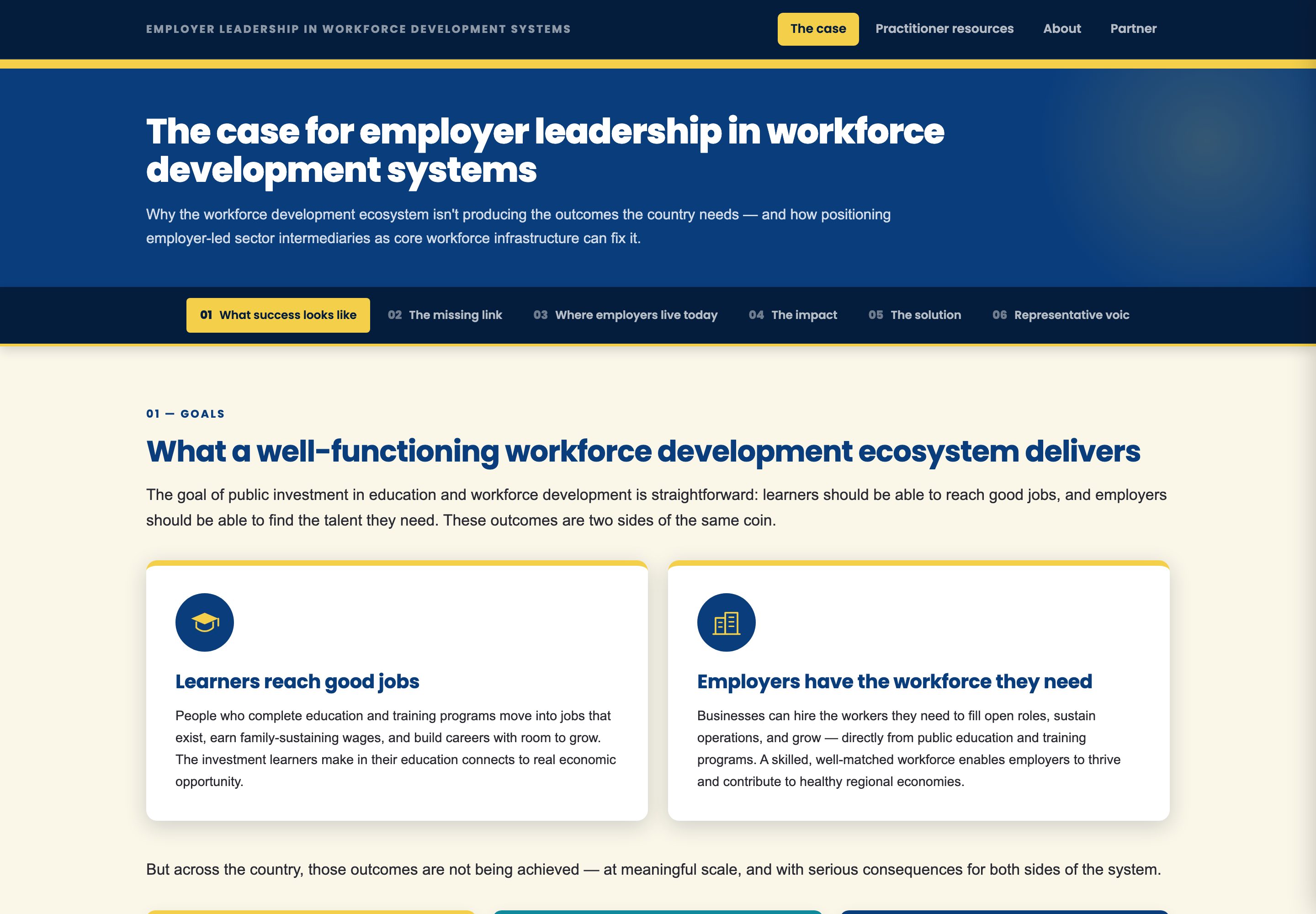
An interactive resource developed in partnership with a cross-state collaborative, making the case for employer leadership in workforce systems — with frameworks, case studies, and recommendations for policymakers, intermediaries, and funders.

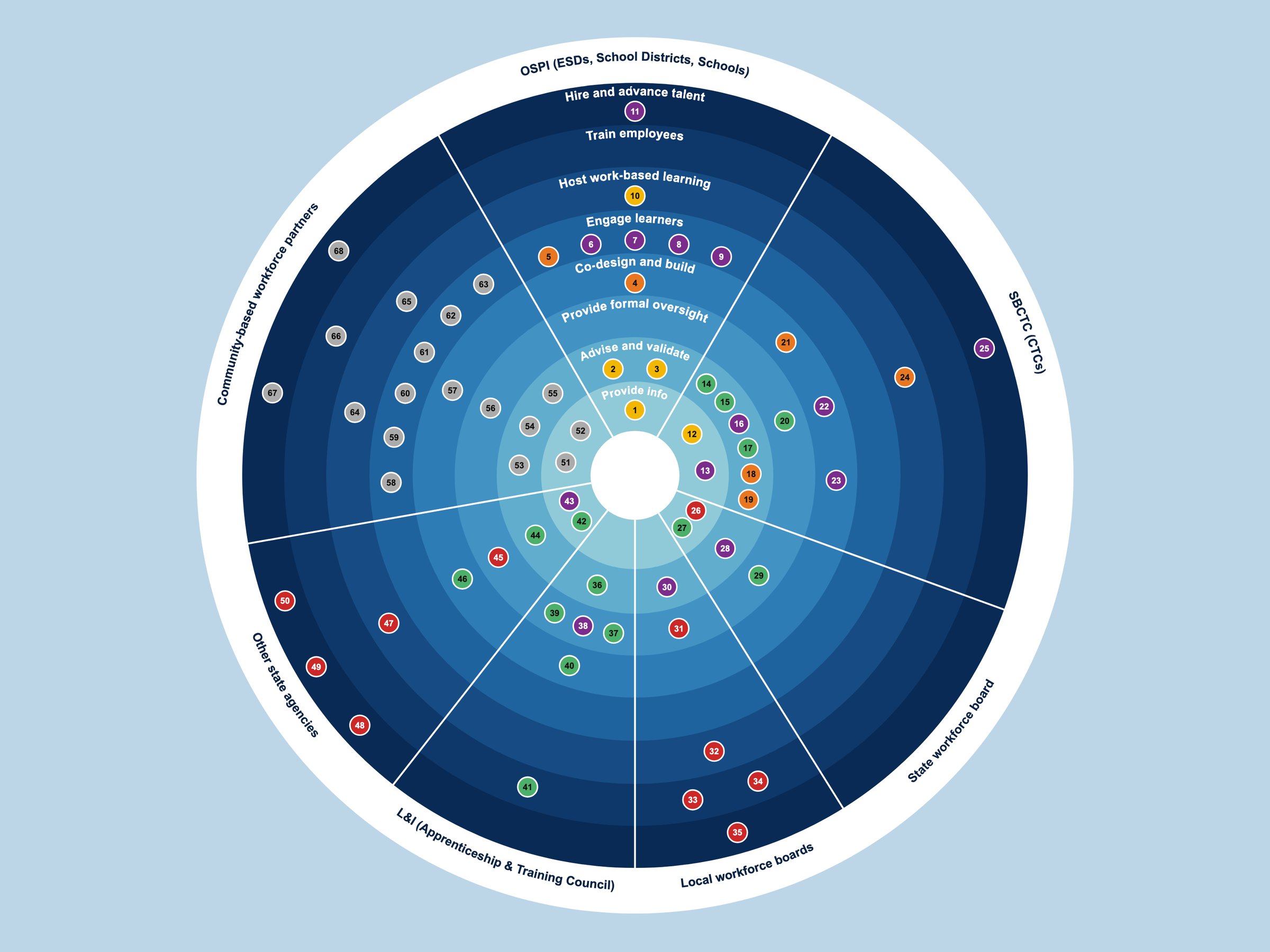
An interactive dashboard mapping more than 65 ways Washington's public education and workforce systems engage employers, built for the Washington Roundtable's Partnership for Learning.
A sample of the organizations Pathfinder Strategies has supported.
Articles on sector intermediaries, employer leadership, and building durable workforce infrastructure — published regularly on Substack.
A reframe of employer engagement — from passive advisory roles to genuine decision-making authority, across a four-level spectrum from participation to shared governance.
Lessons from supporting nearly twenty sector intermediaries across ten industries — a guide to building coordinated ecosystems rather than isolated programs.
Why thousands of fragmented advisory committees produce weak demand signals — and how to right-level the work across sector bodies, local committees, and compliance functions.
Why programs alone can't reach meaningful scale — and why funding career navigators for learners and sector intermediaries for employers is what makes training deliver.
The case for shifting from employer input to genuine authority and shared accountability — and the four converging trends that make this the moment to redesign how decisions get made.
Catalytic employer coalitions, standing sector tables, and embedded state structures — three emerging models that give employers an active leadership role in workforce systems.
New articles on workforce systems, delivered to your inbox.
Ashley Carter is the founder and principal of Pathfinder Strategies. She partners with states, sector intermediaries, and philanthropic organizations to build workforce strategies and systems that respond to real employer demand while expanding access and success for students and jobseekers. Her practice blends strategy development, systems design, and on-the-ground implementation, informed by more than two decades of experience across the public, private, and nonprofit sectors.
Through Pathfinder Strategies, Ashley's engagements span the full arc of this work: providing multi-year technical assistance to statewide sector intermediaries, advising regional partnerships funded through the federal Good Jobs Challenge, mapping employer engagement across a state's education and workforce systems, co-leading a cross-state collaborative advancing employer leadership, shaping statewide workforce policy, and advising philanthropy on new workforce investments.
Before founding Pathfinder Strategies, Ashley was the founding chief operating officer of CareerWise Colorado, where she helped bring the organization's early vision to life and led efforts to scale youth apprenticeship across a range of industries — guiding growth strategy, building core operational systems, and supporting other states in launching programs through the formation of CareerWise USA.
Earlier in her career, Ashley advised Fortune 500 companies and philanthropic foundations at Boston Consulting Group; today she serves as an external advisor to McKinsey. In 2001, she founded Daring Girls, a nonprofit supporting girls' education and entrepreneurship training across East Africa — now more than 25 years old and recognized with UNESCO's 2022 Prize for Girls' and Women's Education.
Whether you're shaping a new investment, strengthening an intermediary, or rethinking how employers lead within your system, the first step is a conversation.